
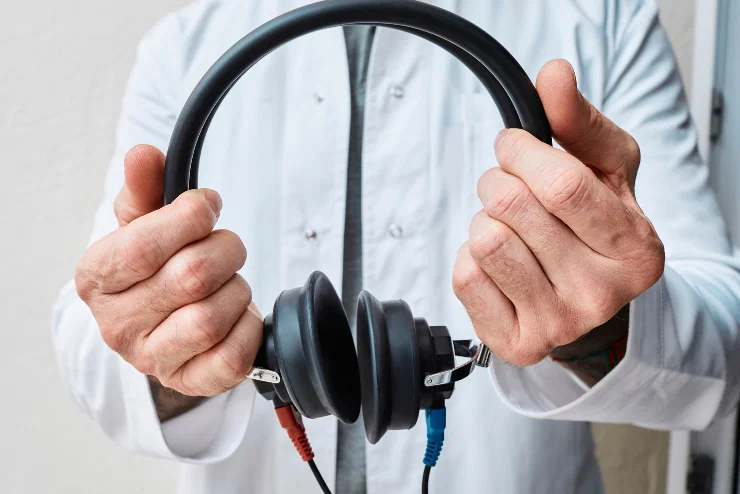
If you or someone you know has noticed hearing changes, you may be wondering if it’s time for an audiology test. It is a common and completely routine step, but it is natural to want to know what actually happens before you go. This guide walks through what an audiology test involves, what it checks, how to prepare and what your results might mean, so you can attend your appointment feeling informed rather than anxious.
What is an audiology test?
An audiology test is a professional assessment of your hearing and related ear function, carried out by a trained audiologist. It is used to understand how well you hear across different sounds and frequencies and to identify whether anything in the ear or hearing pathway may be affecting this.
The exact tests used during an audiology assessment depend on your symptoms, your medical history and what the audiologist feels is clinically appropriate for you. Some appointments involve a straightforward hearing test, while others include a fuller assessment with an ear examination and several types of testing. There is no single fixed format that applies to every patient, which is why the term ‘audiology assessment’ is often used to describe the broader process rather than one specific test.
Why might you need an audiology test?
People seek an audiology test for many different reasons and it is not always because they are certain something is wrong. Common reasons include:
- Difficulty following conversations, particularly in groups
- Frequently asking people to repeat themselves
- Struggling to hear clearly in noisy places such as restaurants or family gatherings
- Turning the television or radio up louder than others seem to need
- Noticing ringing, buzzing or other sounds in the ears, known as tinnitus
- General concern about changes in hearing, even without a specific trigger
- Family members or friends pointing out that hearing seems to have changed
It is worth being clear that experiencing one or more of these signs does not automatically mean you have hearing loss. There can be several explanations for changes in hearing, some temporary and some longer term. An audiology test is simply the way to find out what is actually happening, rather than guessing.
What does an audiology test check?
An audiology assessment can help establish a number of things about your hearing and ear health. Broadly, it can help identify:
- Your hearing sensitivity, meaning the quietest sounds you are able to hear at different pitches
- Whether hearing loss is present and, if so, roughly what type and degree it appears to be
- Whether the outer or middle ear is functioning normally
- Whether further investigation or referral to another healthcare professional may be appropriate
Not every test result points to a problem. Many people who have an audiology test are found to have hearing within a normal range and the appointment simply provides reassurance and a baseline for the future.
What happens during an audiology test?
An audiology appointment usually follows a similar general order, although the specific tests used will vary depending on your situation.
1. Discussing your hearing and medical history
The audiologist will usually begin by asking about your hearing concerns and general health. This conversation helps them understand the context behind your symptoms and decide which tests are most relevant. You may be asked about:
- When you first noticed changes in your hearing
- Whether one or both ears are affected
- Any history of ear infections, ear surgery or noise exposure
- Relevant medical conditions or medications
- Situations in daily life where you find hearing difficult
This discussion is a normal and important part of the assessment, not a formality. It gives the audiologist useful clinical context that a hearing test alone cannot provide.
2. Examining your ears
Many audiology appointments include a visual examination of the ear canal and eardrum, sometimes called otoscopy. This is usually done using a small handheld instrument with a light. It allows the audiologist to check for earwax build-up, signs of infection or other visible issues that could be affecting your hearing or the accuracy of the test results.
3. Pure tone audiometry
Pure tone audiometry is one of the most commonly used hearing tests. You will typically wear headphones or soft ear inserts and a series of tones will be played at different pitches and volumes, one ear at a time. You will usually be asked to respond, for example by pressing a button, whenever you hear a sound, even if it is very quiet.
This test measures the quietest level at which you can detect sounds across a range of frequencies. The results are plotted to create an audiogram, which is explained in more detail later in this guide.
4. Speech audiometry
Speech audiometry looks at how well you can hear and understand speech, rather than simple tones. You may be asked to repeat back words or short phrases, sometimes with background noise present. This helps the audiologist understand how hearing changes affect your ability to follow real conversation, which does not always match perfectly with tone-based results alone.
5. Tympanometry
Tympanometry checks how well your eardrum moves and gives information about the condition of the middle ear. A small soft probe is placed gently at the entrance of the ear canal and a slight change in air pressure is applied. This is not a hearing test in the traditional sense, but it can help identify issues such as fluid behind the eardrum, a perforation or reduced eardrum movement, which may be relevant to your overall results.
6. Other audiology tests you may need
Depending on your symptoms and what the audiologist finds during your appointment, further tests may sometimes be recommended. These are not required for every patient but can include:
- Otoacoustic emissions testing, which checks the response of the inner ear to sound
- Acoustic reflex testing, which looks at an automatic muscle response in the middle ear
- Auditory brainstem response testing, which is used in more specific clinical situations
If any of these are relevant to you, your audiologist will explain why they are being suggested and what they involve.
Ready to Find the Best Hearing Aids?
Hearing aids from £1,295. Free hearing test. No waiting list.
Book your FREE hearing test at our Stafford clinic or request a home visit across Staffordshire. Get expert advice and personalised hearing aid recommendations from our experienced audiologists.
Call 01785 331560Compare the Best Hearing Aids 2026How long does an audiology test take?
The length of an audiology appointment varies depending on which tests are required and how many aspects of your hearing need to be assessed. A straightforward hearing test may take considerably less time than a fuller audiology assessment that includes a detailed history, ear examination and several types of testing. Rather than expecting one fixed duration, it is more useful to allow enough time to attend without feeling rushed and to ask your provider for guidance when you book.
Is an audiology test painful?
Standard hearing assessments are generally painless. During pure tone audiometry, you will simply hear a series of tones at different volumes through headphones or ear inserts, which does not cause discomfort. Tympanometry involves a brief change in air pressure in the ear canal, which some people describe as a slightly unusual or ticklish sensation rather than pain and it passes quickly. If you have a history of ear pain, recent ear surgery or significant sensitivity, it is worth mentioning this to your audiologist before testing begins.
How to prepare for an audiology test
There is no complicated preparation required for a standard audiology test, but a few practical steps can help the appointment run smoothly.
- Think in advance about your hearing concerns and any specific situations where you struggle to hear.
- Be ready to discuss relevant medical history, including any ear problems, surgery or long-term health conditions.
- Note down any medications you currently take.
- If you already wear hearing aids or use any hearing-related equipment, bring them along.
- If possible, avoid attending with a heavy cold or ear infection, as this can affect results and speak to your provider if you are unwell before your appointment.
Being open with your audiologist about your day-to-day hearing difficulties will help them build a fuller picture than test results alone can provide.
Understanding your audiology test results
Once testing is complete, your audiologist should go through your results with you and explain what they mean in plain language. This is your opportunity to ask questions about anything you do not understand.
What is an audiogram?
An audiogram is a chart used to represent your hearing levels across different frequencies, from low-pitched sounds to high-pitched sounds. Each ear is usually plotted separately, showing the quietest level at which you were able to hear a tone at each frequency tested. It gives both you and your audiologist a visual summary of how your hearing performs across the full range of pitches used in everyday speech and environmental sounds.
What do hearing test results mean?
Hearing results are generally described in terms of how close to typical hearing sensitivity your results fall and, where relevant, the degree of any hearing loss identified. Hearing loss is often described using broad categories, ranging from mild through to more significant loss, although the exact terms and thresholds used can vary slightly between clinics and services.
It is important that these results are not looked at in isolation. Your audiologist should interpret your audiogram alongside the difficulties you described earlier in the appointment, since two people with similar test results may experience quite different levels of impact in daily life.
What happens if hearing loss is found?
If your results show some degree of hearing loss, the appropriate next step will depend on your individual circumstances, including the type and degree of loss, your lifestyle and how much it is affecting you day to day. Possible options that may be discussed include:
- Practical communication strategies and advice
- Monitoring your hearing over time with a follow-up assessment
- Referral for further investigation if the audiologist feels this is needed
- Hearing aids, where appropriate for your situation
Not everyone who is found to have some degree of hearing loss will need hearing aids. Your audiologist should talk through the options relevant to you rather than assuming one single path applies to everyone.
What happens after an audiology test?
After your assessment, your audiologist should discuss your results, what they may mean and any recommended next steps. Depending on your findings, this conversation could cover ongoing support, hearing aid options, a plan to monitor your hearing over time, or referral to another healthcare professional if something outside routine hearing care needs further attention. You should leave your appointment with a clear understanding of your results and what, if anything, happens next.
If you are exploring options such as hearing aids, it can help to also look at hearing aid prices so you know roughly what to expect before any decisions are made.
Audiology test vs. hearing test: what is the difference?
The terms ‘audiology test’ and ‘hearing test’ are often used interchangeably and in everyday conversation this is generally fine. However, there is a subtle difference worth understanding.
A hearing test commonly refers specifically to tests that measure your hearing ability, such as pure tone audiometry.
An audiology assessment can be broader. It may include a hearing test as one part of the appointment, alongside a discussion of your medical history, an ear examination and, where relevant, additional tests such as tympanometry or speech audiometry.
In short, a hearing test is often one component within a wider audiology assessment, rather than a completely separate process.
When should you book an audiology test?
It is generally reasonable to consider booking an audiology test if you notice gradual changes in your hearing, find yourself struggling more in conversations or noisy environments, or if people around you have mentioned a change. Booking earlier rather than later can make it easier to understand what is happening and to explore support options if needed.
A free hearing test or home hearing test can be a helpful starting point if you are simply unsure whether further assessment is needed.
It is important to highlight one exception to this general guidance. If you experience sudden hearing loss, particularly in one ear, or your hearing worsens rapidly over a short period, this should not be treated as a routine hearing test appointment. NHS guidance and UK hearing charities advise that sudden hearing loss should be treated as a medical concern requiring prompt attention, since early assessment can be important for identifying the cause. If this happens to you, contact your GP or call NHS 111 as soon as possible, rather than waiting for a standard audiology appointment.
Frequently asked questions about audiology tests
An audiology test is a professional assessment of your hearing and ear function carried out by an audiologist. It usually involves discussing your symptoms and history, an ear examination and one or more hearing tests, such as pure tone audiometry, to establish how well you hear across different frequencies.
The length of an audiology test varies depending on which tests are needed. A simple hearing test may be shorter, while a fuller assessment that includes a history, ear examination and several tests will generally take longer. It is best to check expected timing when you book.
No, standard audiology tests are generally painless. Pure tone audiometry simply involves listening to tones through headphones and tympanometry involves a brief, mild pressure change in the ear canal that does not cause pain for most people.
An audiology test can check your hearing sensitivity across different frequencies, whether hearing loss is present and its likely type and degree and how well your outer and middle ears are functioning. It can also help identify whether further investigation is appropriate.
Think about your hearing concerns and any situations where you struggle to hear and be ready to share relevant medical history and medications. Bring any hearing aids or hearing equipment you already use and try to avoid attending with a heavy cold or ear infection where possible.
Your audiologist will explain what your results mean and discuss appropriate next steps based on your individual circumstances. This might include communication advice, monitoring, further investigation or hearing aids, depending on what is relevant for you. Not everyone with hearing loss needs hearing aids.
They are closely related but not always identical. A hearing test usually refers to the specific tests that measure hearing ability, while an audiology assessment can be broader, including a hearing test alongside a history discussion, ear examination and other tests where needed.
There is no single answer that applies to everyone, as this depends on your age, symptoms and any existing hearing concerns. Many people benefit from having their hearing checked periodically, particularly if they notice changes, work in noisy environments or have a family history of hearing loss. Your audiologist can advise on a suitable interval for your circumstances.
Book Your Hearing Test in Staffordshire
If you are experiencing hearing difficulties, booking a hearing test is the first step. Our team at Mi Hearing will assess your hearing and help you find the best hearing aids for your needs.
Book Your Free Hearing TestBook an audiology test with MI Hearing.
If you have noticed changes in your hearing or you simply want peace of mind, booking an assessment is a sensible first step. The team at MI Hearing can talk you through your options, including a free hearing test at the Stafford clinic or in your own home across the surrounding areas. If you would like to discuss your hearing concerns or arrange an appointment, please get in touch and the team will be happy to help.